SS4A The FY2026 Safe Streets for All NOFO is open — application deadline August 2026. WalkPhase is built for Implementation Grants. See how we fit →

Streets aren't unsafe
by accident.
They're mistimed.

Traffic signals assume people walk at 1.0 m/s.
Many don't.
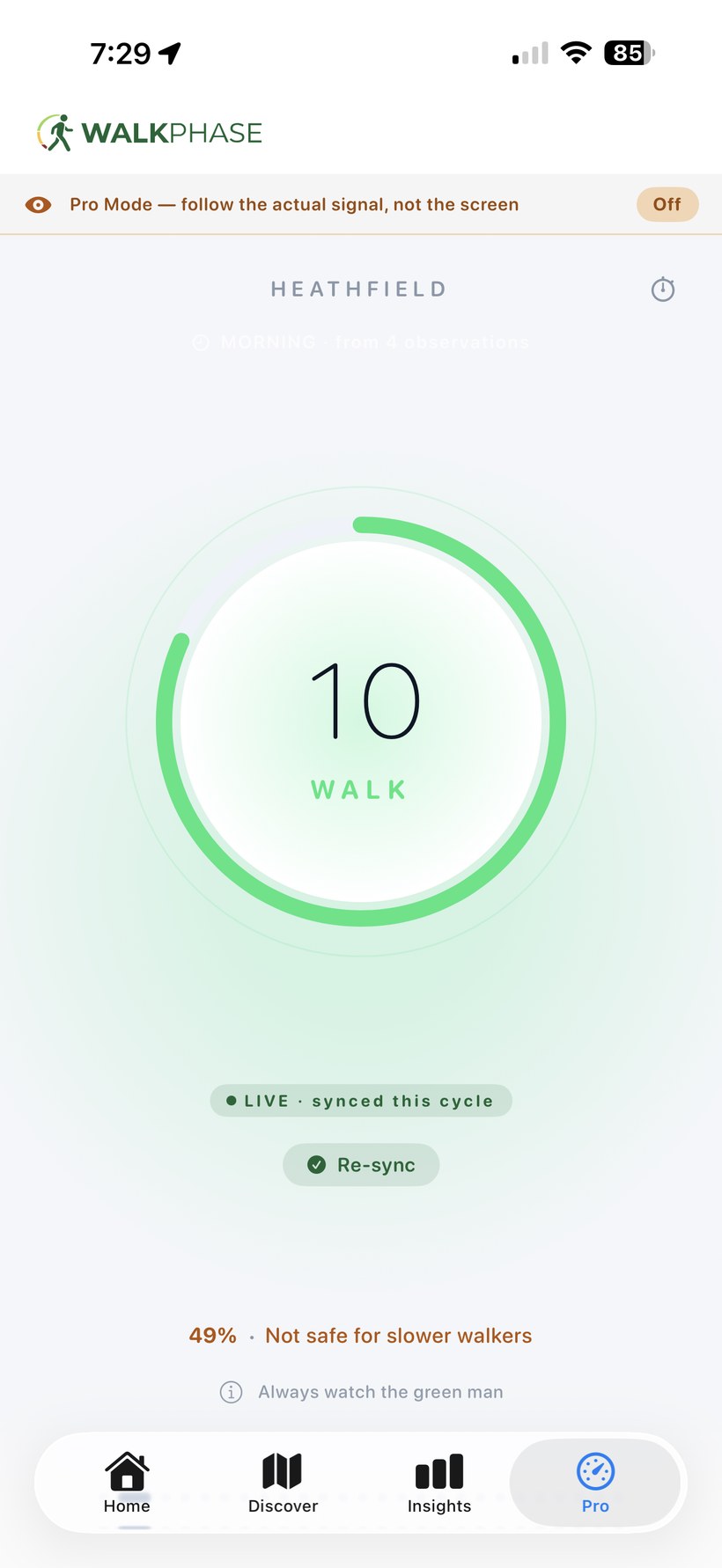
WalkPhase measures the gap — and shows how to fix it.
18
WALK
Speed 0.72 m/s
Required 24.3s
Insufficient time

Designed for 1.0 m/s.
But many people don't walk that fast.

1.0 m/s
Assumed walking speed
18s
Crosses safely
0.7 m/s
Real-world walking speed
18s
Still crossing at zero

Signal timing standards assume a uniform walking speed of 1.0 m/s. But older adults, people with disabilities, parents with children, and many others walk slower. The result: they're still in the road when the signal changes. WalkPhase quantifies this gap at every intersection.

A new layer of infrastructure —
without infrastructure.

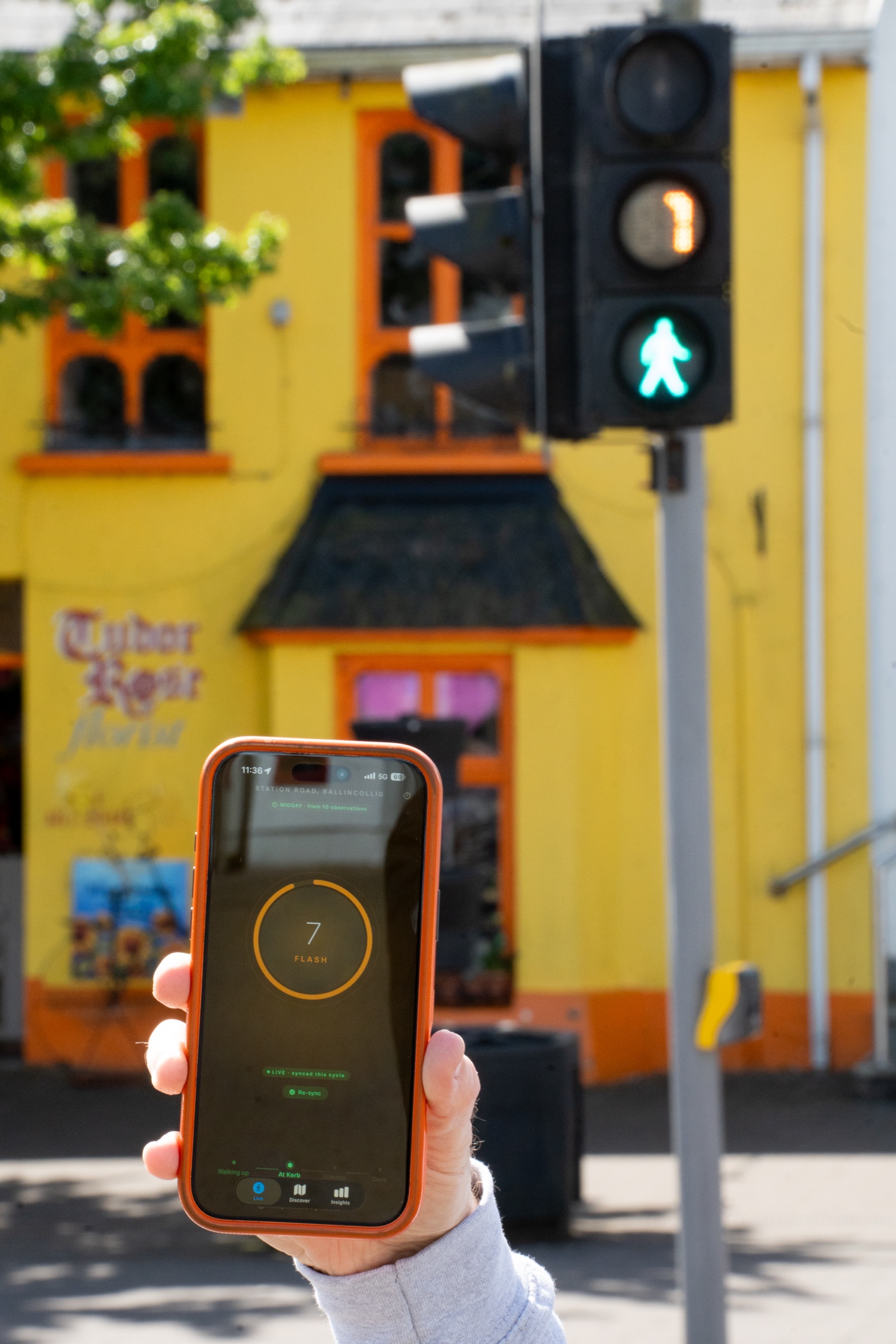
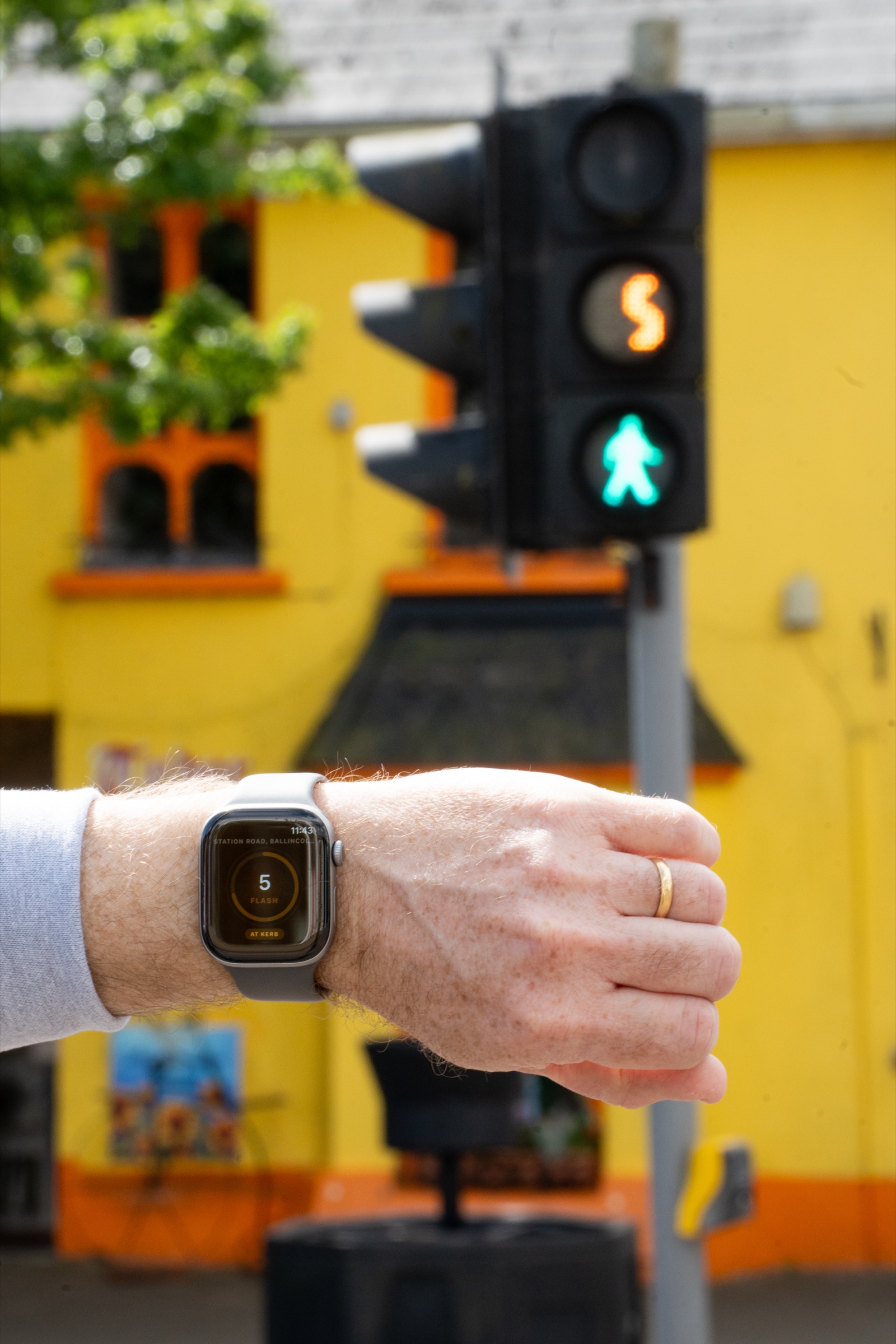
WalkPhase turns a smartphone into a pedestrian signal intelligence device.

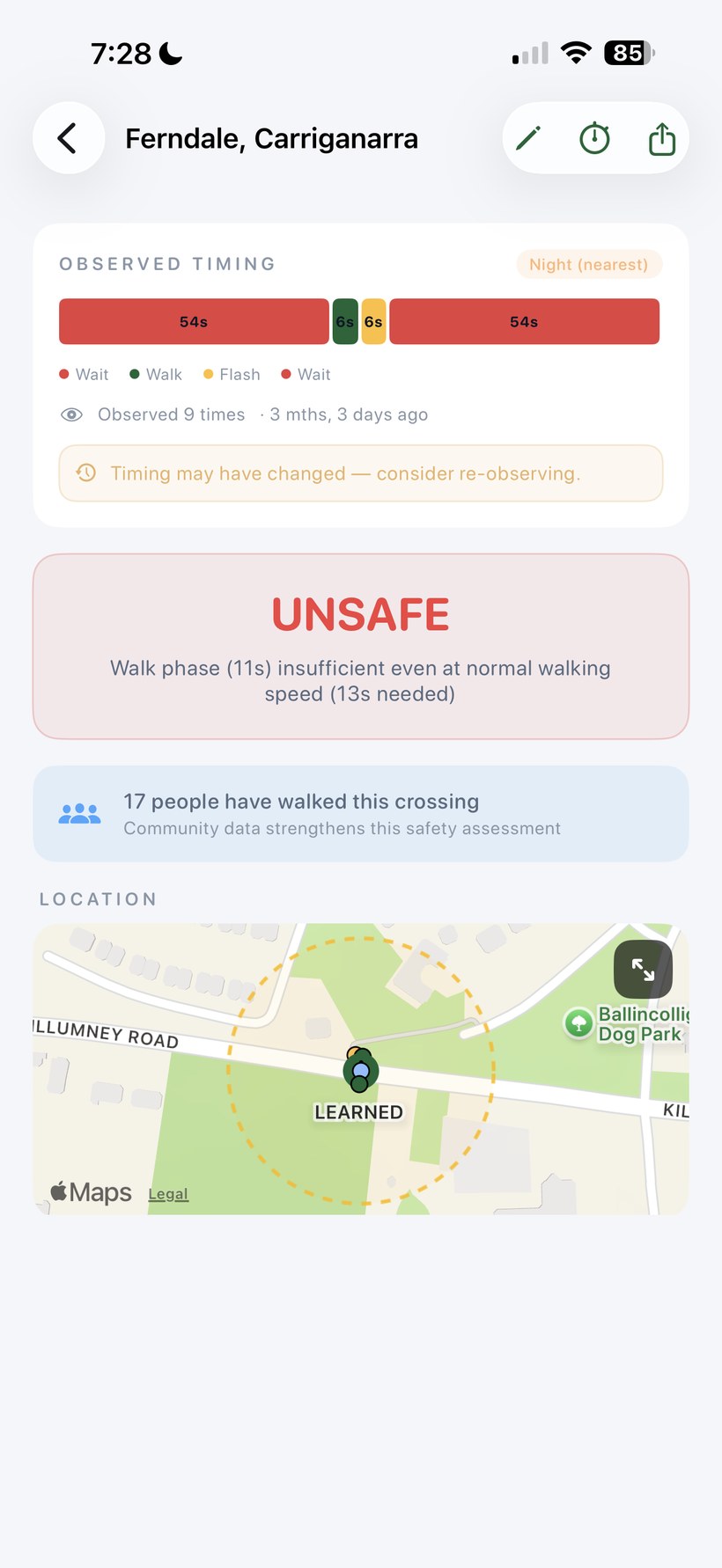
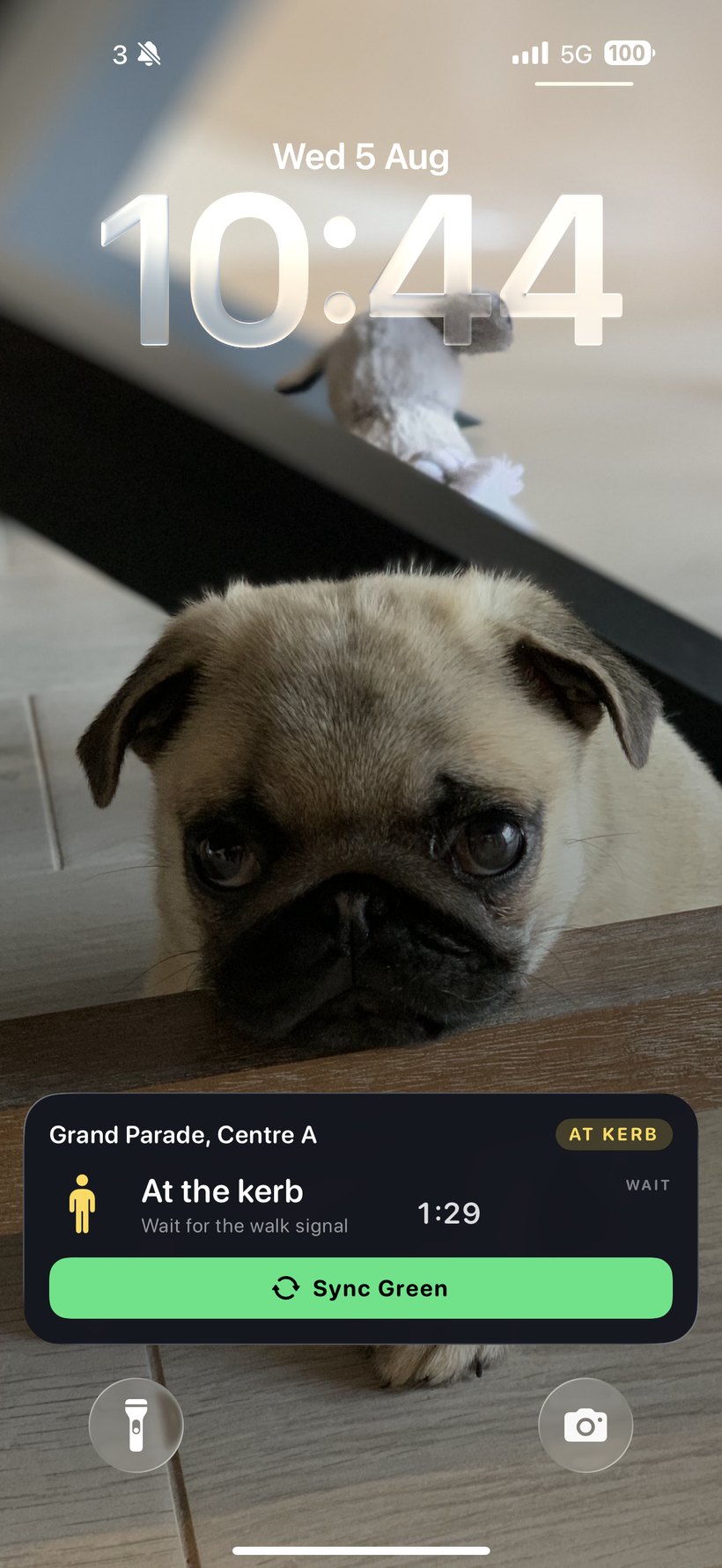
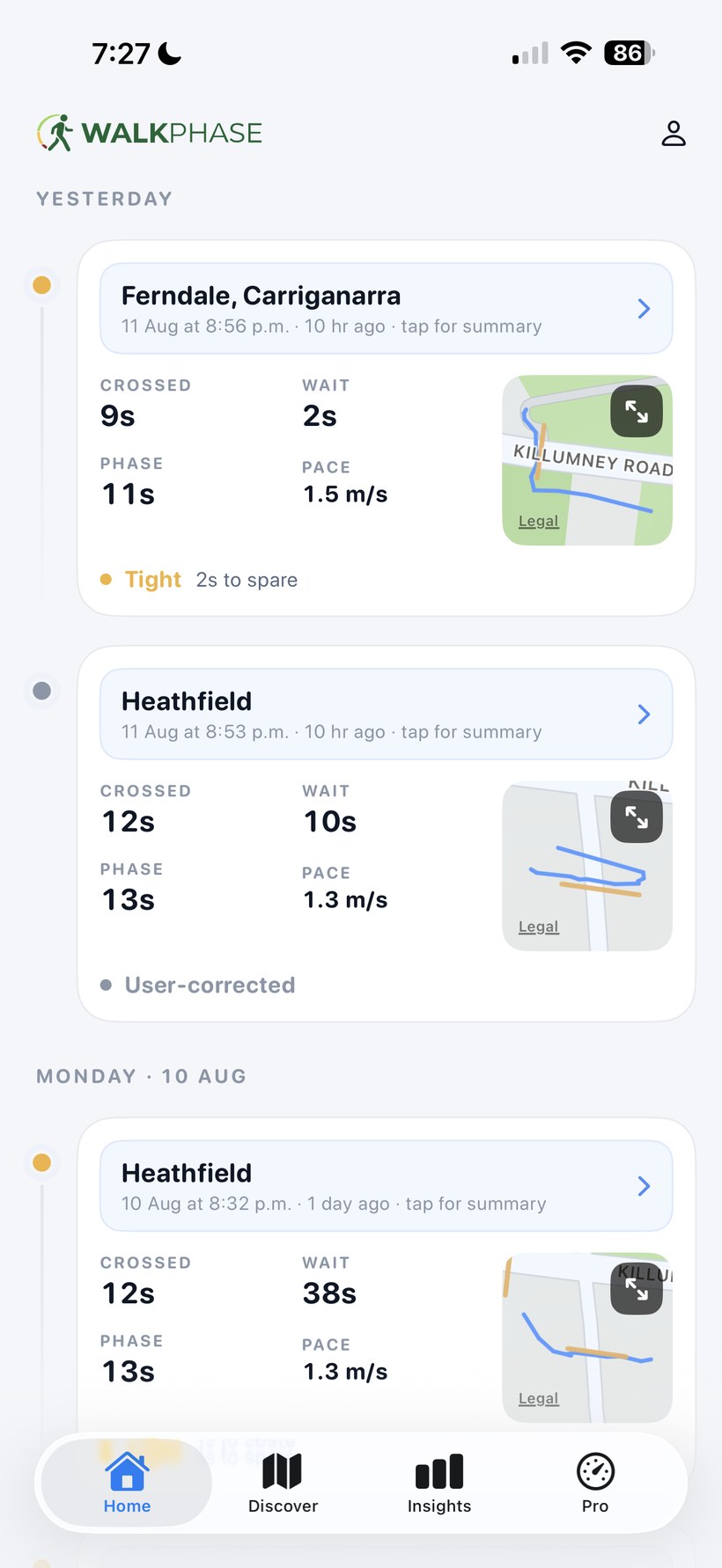
Using on-device intelligence, it detects crossings, learns signal timing patterns, and identifies where real-world conditions don't match design assumptions.

No hardware.
No integration required.
Deployable anywhere.
Countdown
14s remaining
🚶
Walking speed
0.72 m/s
📍
Status
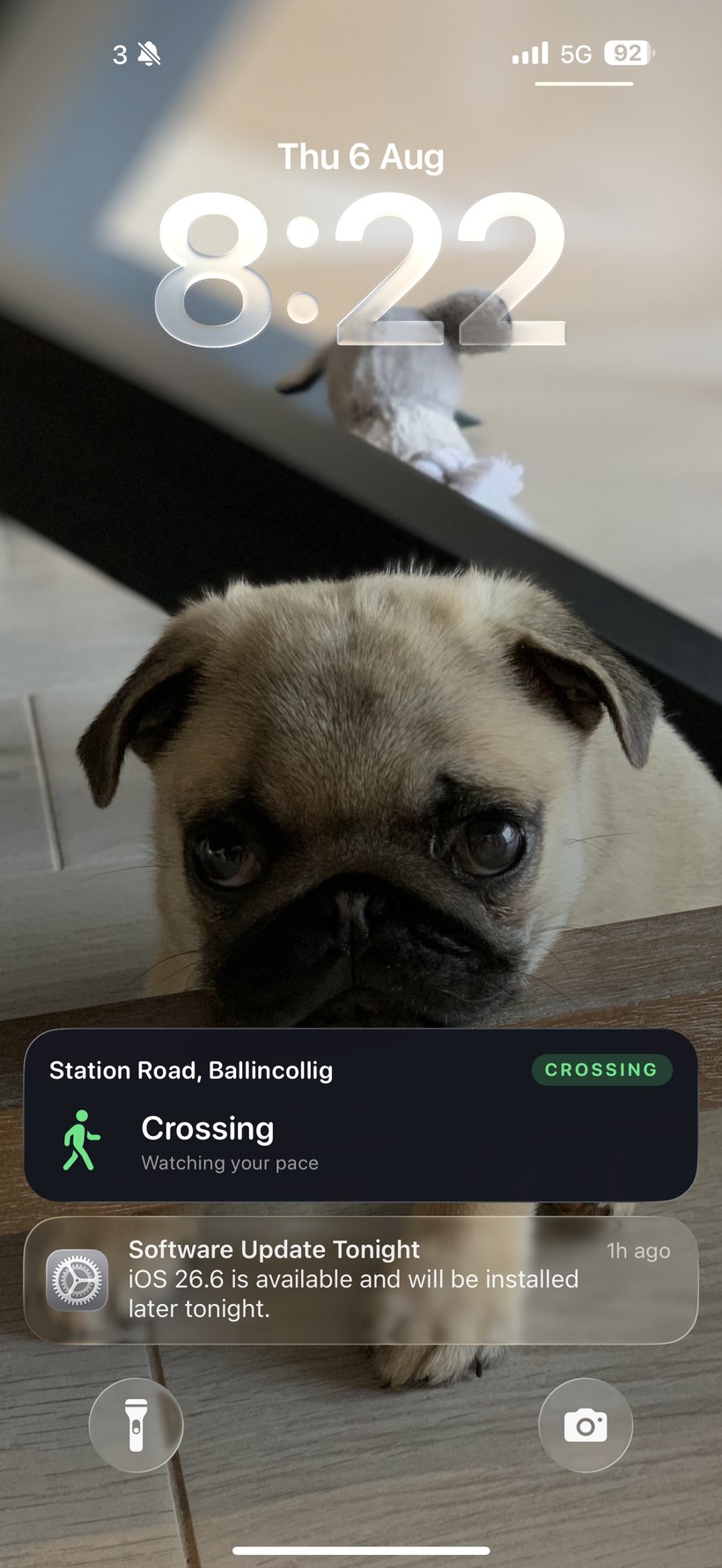
Crossing detected

What WalkPhase measures

Real walking speed

Measures actual pedestrian speed at each crossing — not assumptions from a manual.

Signal timing cycles

Learns how each intersection's signals actually operate over time.

Learned timing model

Crossing detection

Detects when a pedestrian arrives, starts crossing, and completes a crossing.

On-device intelligence

Unsafe crossing identification

Flags intersections where available walk time is insufficient for real-world users.

Extension quantification

Calculates exactly how many additional seconds each crossing needs.

Works anywhere

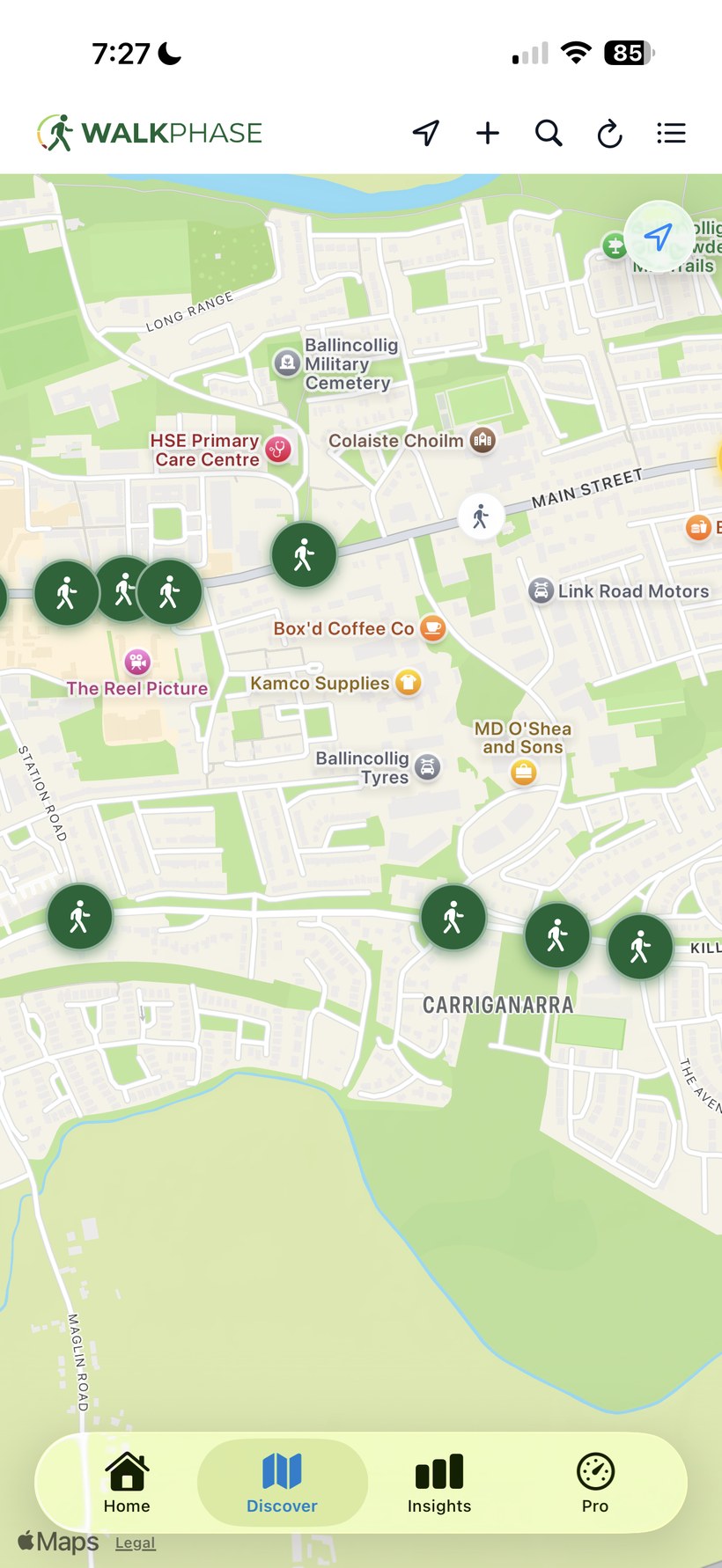
No roadside hardware. No signal controller access. Just a smartphone.

From assumptions
to evidence.

WalkPhase provides the missing layer in pedestrian safety analysis.

34%
of crossings found unsafe
+8.2s
average extension needed
0.68 m/s
average observed speed (vs 1.0 assumed)
100%
on-device processing

Illustrative figures based on early pilot data and published research on pedestrian walking speeds.

Built on real-world data.
Powered by intelligence.

WalkPhase uses on-device intelligence to understand how people move through intersections — and how signals actually behave.

01

Crossing Detection

Automatically detects when a pedestrian arrives, starts crossing, and completes a crossing — using motion and location data on-device.

Crossing detected
02

Signal Timing Learning

Learns how each intersection operates over time — without infrastructure access or signal controller integration.

Cycle: 72s
03

Risk Identification

Identifies crossings where available walk time is insufficient for real-world users — especially older adults and people with mobility limitations.

+7.2s needed
04

Prioritisation Insights

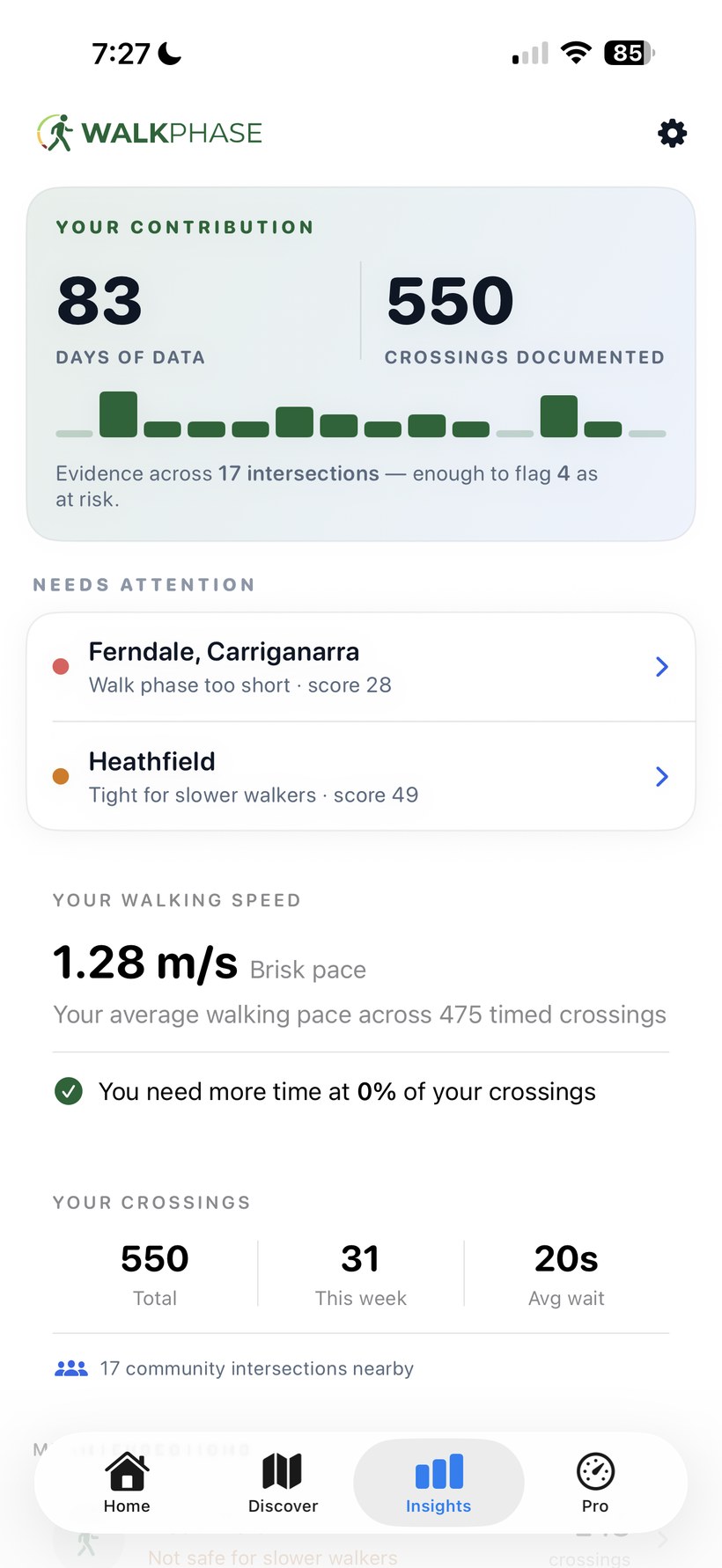
Helps cities identify which intersections require intervention first — ranked by risk, equity impact, and feasibility.

0.68 m/s avg

Why WalkPhase is built for
Safe Streets for All.

Every element of WalkPhase aligns with the priorities outlined in the SS4A Implementation Grant NOFO.

Data-driven safety analysis

Real walking speed data at every intersection — not estimates or averages from a manual.

On-device AI / cutting-edge technology

Patented crossing detection and signal timing learning — all processed on-device with no cloud dependency.

Protects the most vulnerable

Directly measures outcomes for older adults, people with disabilities, children, and anyone who doesn't walk at 1.0 m/s.

Works anywhere — no infrastructure

No roadside hardware, no signal controller access. Deploy across any intersection with a standard smartphone.

Integrated with FARS data

Cross-references crossing risk with national fatality data to support equity-weighted prioritisation.

Ready to deploy in weeks

Operational within 4–8 weeks. No procurement delays, no infrastructure lead time.

Dashboards and grant-ready reporting

Custom reporting tailored to federal deliverable requirements — walking speeds, timing gaps, equity metrics, and intervention recommendations.

Measurable outcomes for federal reporting

Quantified, intersection-level data that maps directly to SS4A performance metrics and deliverables.

How a pilot works

A small team generates statistically meaningful data in 30 days — no infrastructure, no integration, no delays.

01

Select intersections

Choose 10–15 priority intersections based on crash data, equity concerns, or Action Plan priorities.

02

Deploy participants

10–20 participants carry smartphones with WalkPhase during their normal daily routines — or as dedicated data collectors.

03

Collect crossing data

Over 30 days, each participant generates multiple crossings per intersection. With 15 participants across 10 intersections, a typical pilot produces 1,500+ recorded crossings.

04

Analyse and report

WalkPhase delivers intersection-level safety analysis: real walking speeds, timing gap identification, risk scoring, and prioritised intervention recommendations.

10–20
participants
30
days
1,500+
recorded crossings
10–15
intersections analysed

In 30 days, you get:

📊

Intersection-level safety insights

Equity metrics for vulnerable users

📋

A clear, data-driven case for intervention

How WalkPhase fits into
your SS4A grant.

Select your situation to see the simplest path forward.

Plan
Demonstrate
Implement
Implementation Grant

Apply for an Implementation Grant

  • WalkPhase acts as an Operational / Technology Strategy within your implementation plan
  • Provides intersection-level data to support and prioritise implementation activities
  • Strengthens your application with measurable, equity-focused outcomes

Best path for larger funding and faster deployment

Planning & Demonstration Grant

Apply for a Planning & Demonstration Grant

  • WalkPhase runs as a demonstration activity alongside your planning process
  • Generates real-world pedestrian data while your Action Plan is being developed
  • Directly informs your Safety Action Plan with evidence from the field

Combines planning + real data collection

Planning & Demonstration Grant

Start with a Planning & Demonstration Grant

  • Use WalkPhase to generate baseline safety data at priority intersections
  • Identify high-risk crossings for older adults, people with disabilities, and other vulnerable users
  • Build a data-driven Action Plan grounded in real-world evidence

Fastest way to build a strong, evidence-based application

Structured for
real-world deployment.

Designed to fit within SS4A implementation grants — or run as a direct pilot.

Typical pilot engagements range from $75k to $125k depending on scope.

Direct Pilot

Run independently of grant timelines. Ideal for faster deployment, early validation, or agencies with existing budgets.

  • 5–15 intersections
  • 4–8 week deployment
  • Full data and analysis
  • Flexible timeline
Get in touch

Pilot scope and pricing are tailored to each partner.

Patented technology. 2 U.S. patents granted.

The product team behind WalkPhase brings over 20 years of experience delivering innovative, high-tech pilot programs in partnership with U.S. transportation agencies — from concept through deployment.

WalkPhase is currently in pilot-stage development, with early demonstrations and agency conversations underway.

Let's make crossings safer — together.

Whether you're preparing an SS4A application or exploring a direct pilot, we'd love to hear from you.

Or email us directly at team@walkphase.com